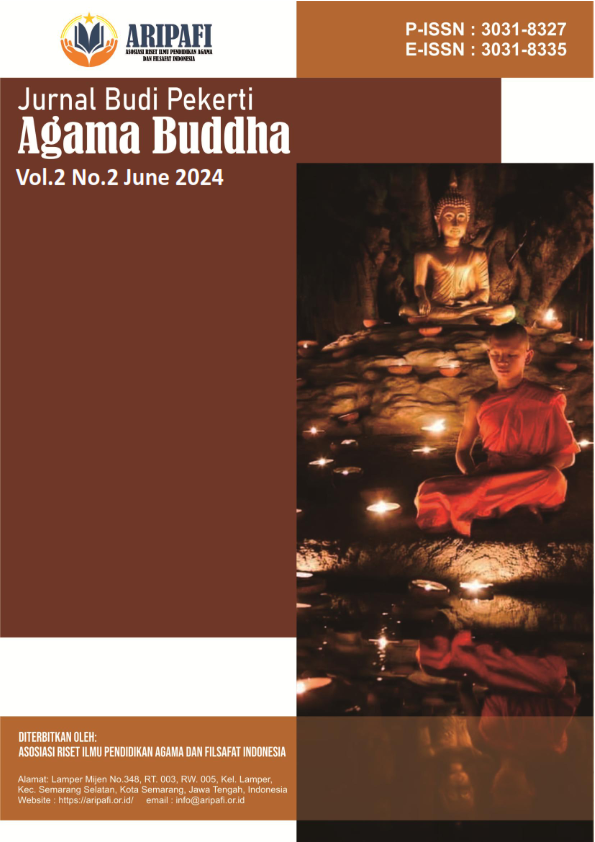
Peluang dan Tantangan Perkembangan Tradisi Agama Buddha di Indonesia: Tri Dharma Sebagai Penguat Tradisi dalam Memperkokoh Agama Buddha
Studi Kasus: Vihara Tri Dharma Bumi Raya, Singkawang
DOI:
https://doi.org/10.61132/jbpab.v2i2.1825Keywords:
Cap Go Meh, Multiculturalism, Religious Syncretism, Singkawang, TatungAbstract
This research examines the opportunities and challenges in the development of Buddhist traditions in Indonesia, with a specific focus on the role of Tri Dharma (三教 Sam Kauw) as a tradition-strengthening element in fortifying Buddhism in Singkawang City, West Kalimantan. The research is grounded in the dynamic development of Buddhism in Indonesia, which has been influenced by modernity and diverse interpretations of teachings. Utilizing a qualitative descriptive method through observation, interviews, and document analysis with religious leaders and Buddhist adherents in Singkawang City, particularly at the historic Vihara Tri Dharma Bumi Raya (established 1873-1878), the findings reveal that the Tri Dharma tradition—integrating Buddhism (佛教), Confucianism (儒教), and Taoism (道教)—holds significant potential in strengthening religious identity and practices through values of wisdom, virtue, and harmony integrated into daily life. The research identifies key opportunities including strong cultural identity, vibrant ritual traditions (Cap Go Meh festival, Tatung rituals), community support structures, and religious tourism potential. However, challenges include limited deep understanding of Tri Dharma teachings among younger generations, influences of popular culture that erode traditional values, pressures of globalization, and modernization impacts. The research implications emphasize the necessity of systematic efforts in socializing and internalizing Tri Dharma teachings through formal and non-formal education, digital media engagement, youth involvement in Vihara activities, tradition documentation and preservation, and inter-Vihara collaboration to ensure Buddhist traditions continue to develop and strengthen their existence in Indonesia's pluralistic society.
Downloads
References
Analayo, B. (2013). Dukkha. In A. L. C. Runehov & L. Oviedo (Eds.), Encyclopedia of sciences and religions (pp. 656–657). Springer. https://doi.org/10.1007/978-1-4020-8265-8_1616
Bodhi, B. (Trans.). (2000). The connected discourses of the Buddha: A translation of the Saṃyutta Nikāya. Wisdom Publications.
Collins, S. (1982). Selfless persons: Imagery and thought in Theravāda Buddhism. Cambridge University Press. https://doi.org/10.1017/CBO9780511621499
Coogan, M. D. (Ed.). (2003). The illustrated guide to world religions. Oxford University Press.
Gadamer, H.-G. (1975). Truth and method. Seabury Press.
Gethin, R. (1998). The foundations of Buddhism. Oxford University Press.
Herat, M. (Ed.). (2018). Buddhism and linguistics: Theory and philosophy. Palgrave Macmillan. https://doi.org/10.1007/978-3-319-67413-1
Juniardi, K., & Marjito, E. R. (2018). Urgensi pendidikan multikultural dalam masyarakat plural (Studi kasus di Kota Singkawang). Handep: Jurnal Sejarah dan Budaya, 1(2), 17–34. https://doi.org/10.33652/handep.v1i2.11
Kwee Tek Hoay. (1941). Pemandangan Sam Kauw atas sifatnja klenteng-klenteng Tionghoa, maksoed dan toedjoean dari pamoedja’an, kabaekan dan kafaedahan jang didapet oleh si pemoedja. Moestika.
Kwee Tek Hoay. (1942). Apa adanja Sam Kauw: Itoe tiga peladjaran agama jang dianoet oleh pendoedoek di Tiongkok riboean taon lamanja. Moestika.
Miles, M. B., Huberman, A. M., & Saldaña, J. (2014). Qualitative data analysis: A methods sourcebook (3rd ed.). SAGE Publications.
Narada Thera. (1988). The Buddha and his teachings. Buddhist Publication Society.
Rahmayani, A. (2015). Montrado 1818–1858: Dinamika kota tambang emas. Patanjala: Jurnal Penelitian Sejarah dan Budaya, 7(2), 233–248. https://doi.org/10.30959/patanjala.v7i2.105
Ricoeur, P. (1976). Interpretation theory: Discourse and the surplus of meaning. Texas Christian University Press.
Tanggok, M. I. (2015). Agama dan kebudayaan orang Hakka di Singkawang. Balai Pelestarian Nilai Budaya Pontianak.
Wagito. (2017). Vihara Theravada di Kota Singkawang. Jurnal Mahasiswa Arsitektur Untan, 5(1), 53–61. https://media.neliti.com/media/publications/206075-vihara-theravada-di-kota-singkawang.pdf
Walshe, M. (Trans.). (1987). The long discourses of the Buddha: A translation of the Dīgha Nikāya. Wisdom Publications.
Warder, A. K. (2000). Indian Buddhism (3rd ed.). Motilal Banarsidass.
Downloads
Published
How to Cite
Issue
Section
License
Copyright (c) 2024 Jurnal Budi Pekerti Agama Buddha

This work is licensed under a Creative Commons Attribution-ShareAlike 4.0 International License.