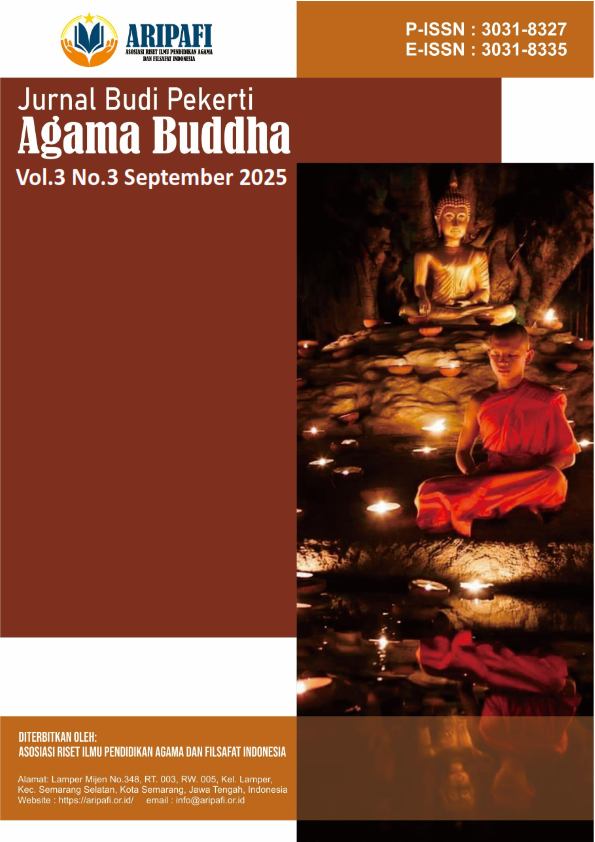
Pengaruh Pelaksanaan Vipassanā Bhavana terhadap Pengendalian Diri (Samvara) para Sastri di Pasastrian Buddha Kusalamitra Gunungkidul
DOI:
https://doi.org/10.61132/jbpab.v3i3.1841Keywords:
Vipassanā Bhavana, self-control, Samvara, Buddha, PasastrianAbstract
Kusalamitra Buddhist Pasastrian in Gunungkidul is one of the institutions that organizes non-formal education. Kusalamitra Buddhist Pasastrian is engaged in non-formal education and training that is social and religious in nature. The Kusalamitra Buddhist Pasastrian organizes religious education and training such as Dharma guidance, meditation practice, religious ceremony practice, guidance and training of Buddhist youth. The habituation of behaving based on Buddhist teachings is the main goal of this Pasatrian Education. One of the education and training programs at the Kusalamitra Buddhist Pasastrian is vipassanā bhavana training. Some students are diligent in implementing vipassanā bhavana, but some are not diligent. In addition, there are still some students who do not have good self-control (samvara). The purpose of the study was to determine the effect of the implementation of vipassanā bhavana on the self-control (samvara) of students at the Kusalamitra Buddhist Pasastrian. This study is a quantitative study with a population of 44 students. The results of the study showed that the implementation of vipassanā bhavana had an effect on self-control (samvara), by 55% and the remaining 45% was influenced by other factors.
Downloads
References
Anālayo, B. (2013). The legality of bhikkhunī ordination. Journal of Buddhist Ethics, 20.
Carter, E. C., McCullough, M. E., & Carver, C. S. (2012). The mediating role of monitoring in the association of religion with self-control. Social Psychological and Personality Science, 3(6), 691–697. https://doi.org/10.1177/1948550612438925
Casey, B. J., Getz, S., & Galvan, A. (2008). The adolescent brain. Developmental Review, 28(1), 62–77. https://doi.org/10.1016/j.dr.2007.08.003
Chattopadhyay, M. (2017). Visuddhimagga. https://doi.org/10.1007/978-94-024-0852-2_401
Chen, C., Lin, W., & He, G. (2023). The effect of decision strategy on self-control choice. Current Psychology, 42(34), 30472–30484. https://doi.org/10.1007/s12144-022-03961-8
Cornelius, R. R. (2000). Theoretical approaches to emotion. ISCA Archive, 3–10.
Dhammadiro. (2018). Pustak Dhammapada. Yayasan Sammasayambhu.
Ghufron, M., & Risnawati, S. (2011). Teori-teori psikologi. Ar-Ruzz.
Hagger, M. S., & Hamilton, K. (2025). Progress on theory of planned behavior research: Advances in research synthesis and agenda for future research. Journal of Behavioral Medicine, 48(1), 43–56. https://doi.org/10.1007/s10865-024-00545-8
Logue, A. (1995). Self control waiting until tomorrow for what you want today. Prentice Hall.
Luya, D., Martin, & Sukmawati, E. (2024). Analisis self control siswa kelas VIII SMP Yos Sudarso Parindu Kabupaten Sanggau. BIKONS: Jurnal Bimbingan Konseling, 1(1), 121–136.
Muharsih. (2008). Hubungan kontrol diri dengan kecenderungan perilaku konsumtif pada remaja di Jakarta Pusat. UPI.
Ñāṇamoli, B., & Bodhi, B. (2013). Majjhima Nikāya (I. Anggara, Trans.). Dhamma Citta. https://doi.org/10.1007/978-94-024-0852-2_267
Nanamoli, B., & Bodhi, B. (2017). The middle-length discourses of the Buddha. In Buddhist Hell (pp. 15–18). https://doi.org/10.2307/j.ctt1t88tfk.8
Narada. (1993). Cermin kehidupan. Yayasan Dhammadipa Arama.
Piyadasi. (2010). Buddhisme: A living message. Dhammadipa.
Sarao, K. T. S. (2017). Saṃyutta Nikāya.
Sayadaw, M. (2020). Dhammacakkappavattana sutta (1st ed.). Yayasan Dhammavihari (Mahasi).
Steinberg, L. (2007). Risk taking in adolescence. Current Directions in Psychological Science, 16(2), 55–59. https://doi.org/10.1111/j.1467-8721.2007.00475.x
Sugiyono. (2019). Metode penelitian kuantitatif kualitatif dan R & D. Alfabeta.
Thanissaro, B. (2000). Maha-satipatthana Sutta: The great frames of reference.
Thanissaro, B. (2008). Satipatthana Sutta: Frames of reference. 1–9.
Thanissaro, B. (2012). Udana: Exclamations a translation with an introduction & notes.
Tigris, B. (2004). Sepuluh hari dalam meditasi vipassana. Yayasan Dhammadasa.
Walshe, M. (2009). Digha Nikāya: Khotbah-khotbah panjang Sang Buddha. Dhamma Citta.
Wang, C., Huang, P., Jiang, X., Li, Y., Guo, J., Yang, Y., & Guo, M. (2019). Study on the relationship between psychological stress and doctor-patient relationship of cancer patients and their families. Journal of Behavioral and Brain Science, 09(04), 165–173. https://doi.org/10.4236/jbbs.2019.94014
Yang, W. F. Z., Sparby, T., Wright, M., Kim, E., & Sacchet, M. D. (2024). Volitional mental absorption in meditation: Toward a scientific understanding of advanced concentrative absorption meditation and the case of jhana. Heliyon, 10(10), e31223. https://doi.org/10.1016/j.heliyon.2024.e31223
Downloads
Published
How to Cite
Issue
Section
License
Copyright (c) 2025 Jurnal Budi Pekerti Agama Buddha

This work is licensed under a Creative Commons Attribution-ShareAlike 4.0 International License.