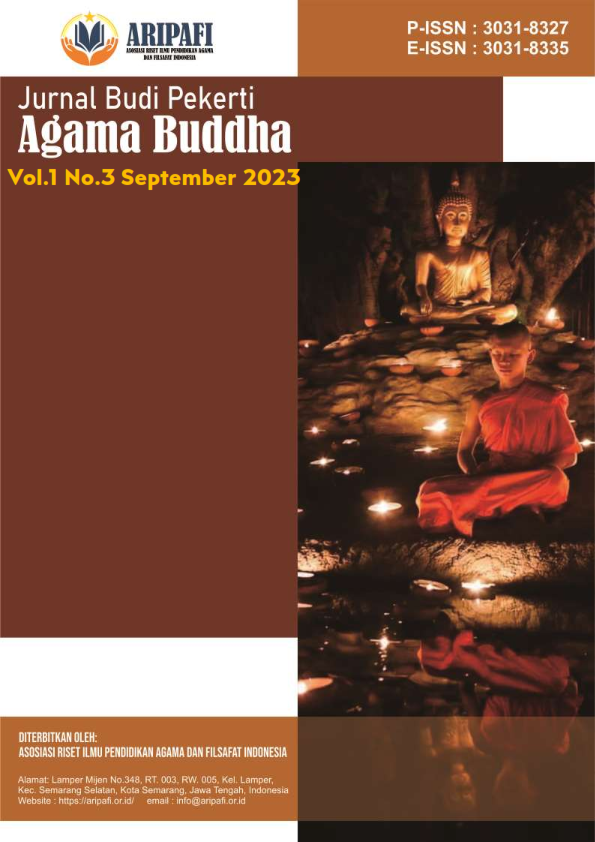
Makna, Simbolisme, dan Tafsiran: Analisis Semantik dan Hermeneutik Teks Agama Buddha dalam Dhammapada dan Sutta Pitaka
DOI:
https://doi.org/10.61132/jbpab.v1i3.1817Keywords:
Buddhism, Dhammapada, hermeneutics, semantics, symbolismAbstract
This study examines the dynamics of meaning, symbolism, and interpretation in Buddhist religious texts through semantic and hermeneutic approaches using qualitative methods. The research explores how the structure of meaning in texts such as the Dhammapada and Sutta Pitaka shapes understanding of Buddhist values, and how teachings in symbols such as the Middle Way, Three Jewels, and Nirvana undergo transformations of meaning according to cultural contexts. The findings show that the understanding of Buddhist text meanings is not fixed, but dynamic, formed through interactions between text, context, and readers. This research employs semantic analysis to identify denotative and connotative meanings, combined with hermeneutic interpretation following Gadamerian and Ricoeurian frameworks. The results reveal that Buddhist symbols carry multilayered meanings that require contextual interpretation, contributing to contemporary understanding and application of Buddhist teachings in diverse cultural settings
Downloads
References
Anālayo, B. (2017). Early Buddhist meditation studies. Barre, MA: Barre Center for Buddhist Studies.
Barthes, R. (1972). Mythologies. New York: Hill and Wang.
Bodhi, B. (Ed.). (2005). In the Buddha's words: An anthology of discourses from the Pali canon. Boston: Wisdom Publications.
Burlingame, E. W. (1921). Buddhist legends: Translated from the original Pali text of the Dhammapada commentary. Cambridge, MA: Harvard University Press. https://doi.org/10.4159/harvard.9780674593411
Collins, S. (2010). Nirvana: Concept, imagery, narrative. Cambridge: Cambridge University Press. https://doi.org/10.1017/CBO9780511761850
Creswell, J. W., & Poth, C. N. (2018). Qualitative inquiry and research design: Choosing among five approaches (4th ed.). Thousand Oaks, CA: Sage Publications.
Ditrich, T. (2022). The ethical foundations of Buddhist cognitive models: Revisiting the Abhidhamma and relating it to phenomenology. Asian Studies, 10(1), 371-398. https://doi.org/10.4312/as.2022.10.1.371-398
Eliade, M. (1961). The sacred and the profane: The nature of religion. New York: Harper & Row.
Gadamer, H.-G. (1989). Truth and method (2nd ed.). New York: Continuum.
Gethin, R. (1998). The foundations of Buddhism. Oxford: Oxford University Press.
Gombrich, R. (2009). What the Buddha thought. London: Equinox Publishing.
Harvey, P. (2013). An introduction to Buddhism: Teachings, history and practices (2nd ed.). Cambridge: Cambridge University Press. https://doi.org/10.1017/CBO9780511800924
Lakoff, G., & Johnson, M. (2003). Metaphors we live by. Chicago: University of Chicago Press. https://doi.org/10.7208/chicago/9780226470993.001.0001
Leech, G. N. (1981). Semantics: The study of meaning (2nd ed.). London: Penguin Books.
Lopez, D. S. (2016). The idea of text in Buddhism: Introduction. Journal of Indian Philosophy, 50, 681-705. https://doi.org/10.1007/s10781-022-09517-1
Lyons, J. (1977). Semantics (Vol. 1-2). Cambridge: Cambridge University Press.
Norman, K. R. (2006). A philological approach to Buddhism: The Bukkyō Dendō Kyōkai lectures 1994. London: School of Oriental and African Studies.
Rahula, W. (1974). What the Buddha taught. New York: Grove Press.
Rhys Davids, T. W., & Stede, W. (1921-1925). The Pali Text Society's Pali-English Dictionary. London: Pali Text Society.
Ricoeur, P. (1976). Interpretation theory: Discourse and the surplus of meaning. Fort Worth: Texas Christian University Press.
Saeed, J. I. (2016). Semantics (4th ed.). Oxford: Wiley-Blackwell.
Walshe, M. (1995). The long discourses of the Buddha: A translation of the Digha Nikaya. Boston: Wisdom Publications.
Williams, P. (2009). Mahayana Buddhism: The doctrinal foundations (2nd ed.). London: Routledge.
Downloads
Published
How to Cite
Issue
Section
License
Copyright (c) 2023 Jurnal Budi Pekerti Agama Buddha

This work is licensed under a Creative Commons Attribution-ShareAlike 4.0 International License.