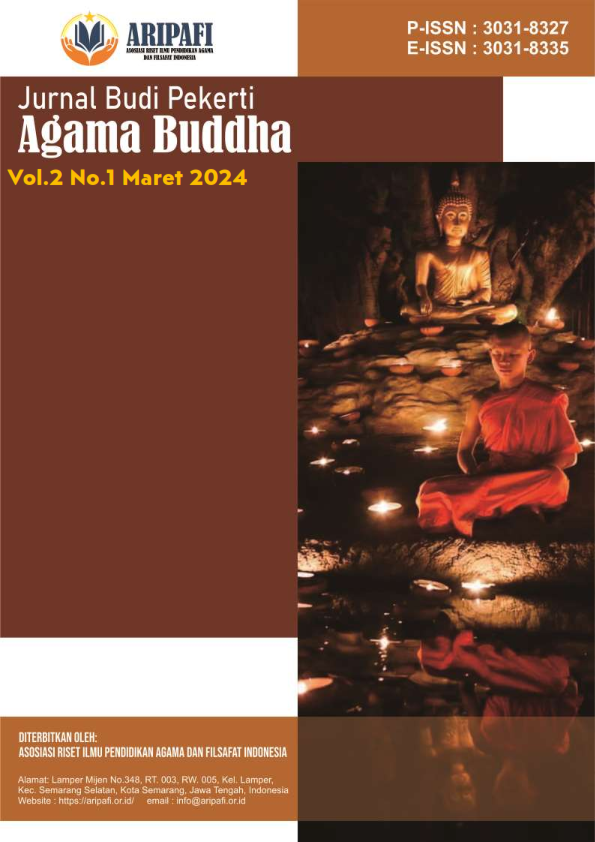
Makna Simbolik dalam Teks Dhammapada
Kajian Semantik Untuk Pendidikan Budi Pekerti Umat Buddha
DOI:
https://doi.org/10.61132/jbpab.v2i1.1821Keywords:
Buddhist education, character education, denotative meaning, Dhammapada, moral valuesAbstract
This study examines the symbolic meanings in the Dhammapada text through a simple semantic approach. Many Buddhists understand the Dhammapada only literally, without exploring the deeper symbolic meanings intended to transform character and behavior. This research uses a descriptive qualitative method by analyzing ten selected verses from the Dhammapada, comparing their literal meanings (denotative) with symbolic meanings (connotative). The findings show that each verse in the Dhammapada contains moral wisdom that can be applied in daily life. For example, the metaphor of light represents wisdom, darkness represents ignorance, and the middle path represents balance in life. These findings have practical implications for Buddhist character education, where understanding symbolic meanings helps students internalize moral values more deeply than merely memorizing texts.
Downloads
References
Beer, R. (2016). The handbook of Tibetan Buddhist symbols. Boston: Shambhala Publications.
Bodhi, B. (2005). In the Buddha's words: An anthology of discourses from the Pali canon. Boston: Wisdom Publications.
Buddharakkhita, A. (2007). The Dhammapada: The Buddha's path of wisdom. Kandy: Buddhist Publication Society.
Collins, S. (2010). Nirvana: Concept, imagery, narrative. Cambridge: Cambridge University Press. https://doi.org/10.1017/CBO9780511761850
Creswell, J. W., & Poth, C. N. (2018). Qualitative inquiry and research design: Choosing among five approaches (4th ed.). Thousand Oaks, CA: Sage Publications.
Eliade, M. (1961). The sacred and the profane: The nature of religion. New York: Harper & Row.
Fajar, A., Saputra, Y., & Nurhayati, H. (2022). Makna bahasa simbolik dalam ajaran Dhammapada: Analisis semantik dan budaya. Jurnal Ilmu Budaya dan Bahasa, 10(1), 55-68. https://doi.org/10.33369/jibb.v10i1.19453
Fronsdal, G. (2016). The Dhammapada: A new translation of the Buddhist classic with annotations. Boston: Shambhala Publications.
Gethin, R. (1998). The foundations of Buddhism. Oxford: Oxford University Press.
Harvey, P. (2013). An introduction to Buddhism: Teachings, history and practices (2nd ed.). Cambridge: Cambridge University Press. https://doi.org/10.1017/CBO9780511800924
Lyons, J. (1995). Linguistic semantics: An introduction. Cambridge: Cambridge University Press.
Narada Thera. (1993). The Dhammapada: Pali text and translation with stories in brief and notes. Kuala Lumpur: Buddhist Missionary Society.
Norman, K. R. (2004). The word of the doctrine (Dhammapada). Oxford: Pali Text Society.
Palmer, F. R. (1981). Semantics (2nd ed.). Cambridge: Cambridge University Press.
Paramita, S., & Sadtyadi, H. (2021). The metaphor of craving in the Tanha Vagga of the Dhammapada scripture: Semantic study of Buddhist texts. Wawasan: Jurnal Ilmiah Agama dan Sosial Budaya, 6(2), 129-140. https://doi.org/10.15575/jw.v6i2.11477
Rahula, W. (1974). What the Buddha taught (2nd ed.). New York: Grove Press.
Roebuck, V. J. (2010). The Dhammapada. London: Penguin Classics.
Schumann, H. W. (2004). The historical Buddha: The times, life, and teachings of the founder of Buddhism. New Delhi: Motilal Banarsidass.
Thanissaro Bhikkhu. (2012). The Dhammapada: A translation. Access to Insight. Retrieved from https://www.accesstoinsight.org/tipitaka/kn/dhp/
Turner, V. (1967). The forest of symbols: Aspects of Ndembu ritual. Ithaca, NY: Cornell University Press.
Wierzbicka, A. (1996). Semantics: Primes and universals. Oxford: Oxford University Press.
Williams, P. (2009). Mahāyāna Buddhism: The doctrinal foundations (2nd ed.). London: Routledge.
Woodward, F. L. (2005). Some sayings of the Buddha according to the Pali canon. Oxford: Pali Text Society.
Downloads
Published
How to Cite
Issue
Section
License
Copyright (c) 2024 Jurnal Budi Pekerti Agama Buddha

This work is licensed under a Creative Commons Attribution-ShareAlike 4.0 International License.