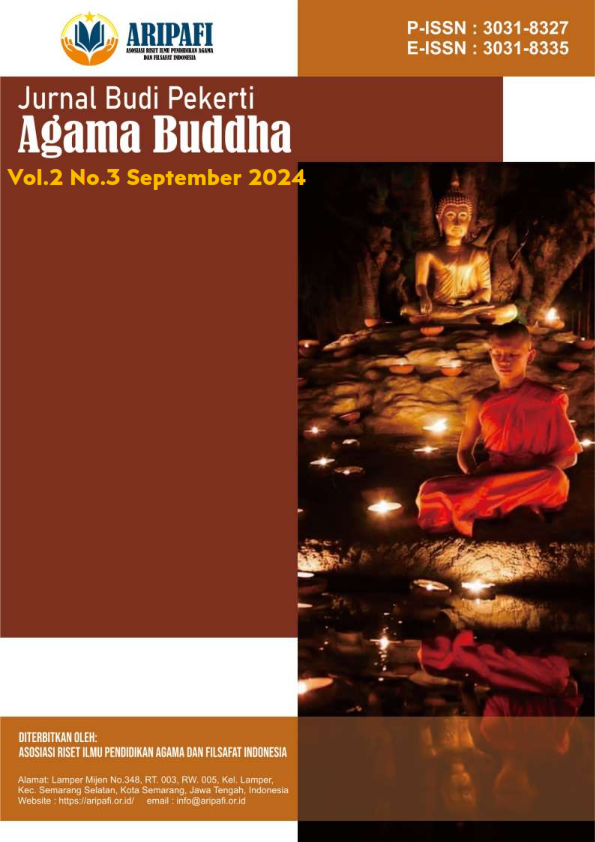
Analisis Semantik Makna Kias Terjemahan Kitab Suci Dhammapada Bab I Yamaka Vaggo Syair 1-10
DOI:
https://doi.org/10.61132/jbpab.v2i3.1828Keywords:
Buddhism, Dhammapada, Gatha, Metaphor, Samma DitthiAbstract
The Dhammapada, a revered Buddhist scripture, is structured in the form of gathas, which are poetic teachings rich in noble values and inspiration for self-development. The beautiful language within the Dhammapada frequently employs lexemes and metaphorical sentences that possess a high degree of vagueness. This vagueness necessitates a literal semantic analysis of meaning so that the text can effectively serve as a guide for ethical and spiritual conduct, as well as a tool for teaching morality, meditation, and wisdom. Semantic studies, which analyze the meaning of lexemes or sentences, are still rarely found within Buddhism. However, semantic studies are crucial for a deep understanding of Buddhist teachings, bridging the gap between literal and philosophical interpretations, and providing a foundation for teaching Dhamma relevant to the modern era. This research utilizes a descriptive method with a literature review approach. The results of the semantic study on the figurative meanings within the Dhammapada indicate that a right view (samma ditthi) regarding unwholesome and wholesome actions can be achieved through mind control, management of the six senses, and eradication of mental defilements (kilesa).
Downloads
References
Anālayo, B. (2017). Early Buddhist meditation studies. Barre Center for Buddhist Studies.
Bodhi, B. (2011). The connected discourses of the Buddha: A new translation of the Saṃyutta Nikāya. Wisdom Publications.
Buddharakkhita, A. (1996). The Dhammapada: The Buddha’s path of wisdom. Buddhist Publication Society.
Burlingame, E. W. (1921). Buddhist legends: Translated from the original Pali text of the Dhammapada commentary. Harvard University Press. https://doi.org/10.4159/harvard.9780674593411
Collins, S. (2010). Nirvana: Concept, imagery, narrative. Cambridge University Press. https://doi.org/10.1017/CBO9780511761850
Creswell, J. W., & Poth, C. N. (2018). Qualitative inquiry and research design: Choosing among five approaches (4th ed.). SAGE Publications.
Dhammadiro, B. (2015). Kamus istilah Buddhisme. Sangha Theravada Indonesia.
Dhammadiro, B. (2018). Pustaka Dhammapada Pali–Indonesia. Sammasayambhu.
Ditrich, T. (2022). The ethical foundations of Buddhist cognitive models: Revisiting the Abhidhamma and relating it to phenomenology. Asian Studies, 10(1), 371–398. https://doi.org/10.4312/as.2022.10.1.371-398
Fronsdal, G. (2005). The Dhammapada: A new translation of the Buddhist classic with annotations. Shambhala Publications.
Gethin, R. (1998). The foundations of Buddhism. Oxford University Press.
Gombrich, R. (2009). What the Buddha thought. Equinox Publishing. https://doi.org/10.1558/isbn.9781845536121
Harvey, P. (2013). An introduction to Buddhism: Teachings, history and practices (2nd ed.). Cambridge University Press. https://doi.org/10.1017/CBO9780511800924
Howarth, G. (2014). The A–Z of death and dying: Social, medical, and cultural aspects. Bloomsbury Academic.
Kaharudin, P. J. (2005). Abhidhammatthasaṅgaha. Vihara Padumuttara.
Lakoff, G., & Johnson, M. (2003). Metaphors we live by. University of Chicago Press. https://doi.org/10.7208/chicago/9780226470993.001.0001
Lij, L. (2020, May 3). Pohon kekotoran batin. Vihara Sasana Subhasita. https://www.sasanasubhasita.org/berita-85-pohon-kekotoran-batin.html
Lopez, D. S. (2016). The idea of text in Buddhism: Introduction. Journal of Indian Philosophy, 50, 681–705. https://doi.org/10.1007/s10781-022-09517-1
Mariyono, A. (2020). Nilai nasionalisme dalam peringatan perayaan hari besar keagamaan secara bersama pada warga Desa Sampetan Boyolali untuk menumbuhkan saddhā. Jurnal Pendidikan, Sains Sosial dan Agama, 6(2), 81–82. https://doi.org/10.53565/pssa.v6i2.231
Mon, T. M., & Mahāsaddhamma Jotikadhaja. (2012). Jalan mulia menuju kebahagiaan abadi: Intisari jalan kesucian (Visuddhimagga) (Vol. 1). Indonesia Tipitaka Center.
Nafinuddin, S. (2020). Pengantar semantik (pengertian, hakikat, dan jenis). OSF Preprints. https://doi.org/10.31219/osf.io/b8ws3
Norman, K. R. (2006). A philological approach to Buddhism: The Bukkyō Dendō Kyōkai lectures 1994. School of Oriental and African Studies.
Parjono. (2022). Ariya aṭṭhaṅgika magga sebagai metode jalan tengah untuk mengatasi ekstremisme: Kajian dalam bingkai agama Buddha. Jurnal Pendidikan, Sains Sosial, dan Agama, 8(1), 1–12. https://doi.org/10.53565/pssa.v8i1.383
Rahula, W. (1974). What the Buddha taught. Grove Press.
Saeed, J. I. (2016). Semantics (4th ed.). Wiley-Blackwell.
Sartika, R., et al. (2020). Pengantar ilmu kajian semantik. CV. Panawa Jemboan.
Sujato, B. (2024). SuttaCentral: Early Buddhist texts, translations, and parallels. https://suttacentral.net
Ubeysekara, A. (2022, August 9). Pentingnya pengendalian indra (indriya saṃvara) dalam ajaran Buddha Theravāda. Dunia Draris. https://drarisworld.wordpress.com/2022/08/09/significance-of-sense-restraint-indriya-samvara-in-theravada-buddhism/
Vihara Sasana Subhasita. (2020, September 22). Lima kekuatan Dhamma yang luar biasa (Pañcabala). Blog Sariputta. https://www.sariputta.com/artikel/ajaran-dasar/konten/lima-kekuatan-dhamma-yang-luar-biasa-pancabala/261
Williams, P. (2009). Mahāyāna Buddhism: The doctrinal foundations (2nd ed.). Routledge. https://doi.org/10.4324/9780203428474
Downloads
Published
How to Cite
Issue
Section
License
Copyright (c) 2024 Jurnal Budi Pekerti Agama Buddha

This work is licensed under a Creative Commons Attribution-ShareAlike 4.0 International License.