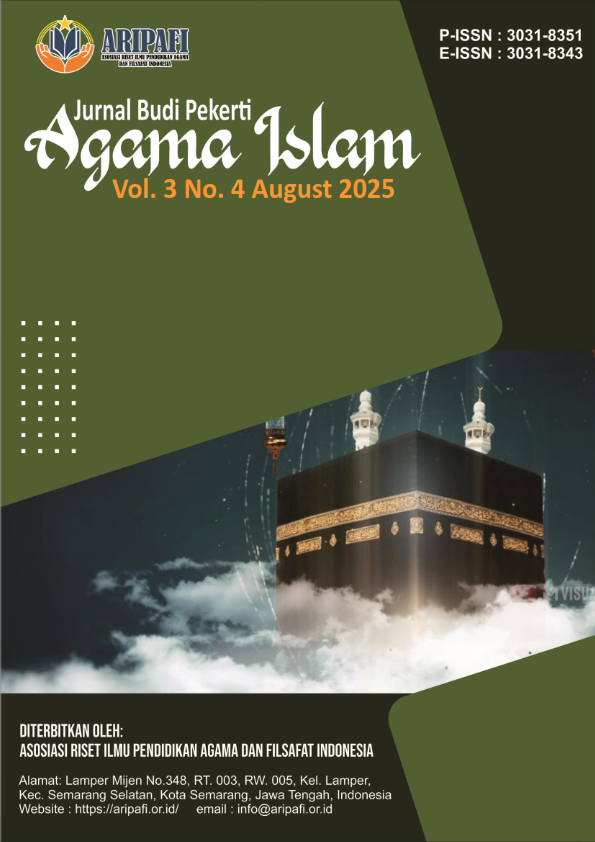
Studi Kritis Bahan Ajar PABP Materi Gibah dan Tabayun di Kelas 7 SMPIT Takhassus Al-Qur’an Ashabiq Sukabumi
DOI:
https://doi.org/10.61132/jbpai.v3i4.1389Keywords:
Authentic Evaluation, Critical Study, Gibah, Independent Curriculum, TabayunAbstract
This study aims to conduct a critical study of the teaching materials for Islamic Religious Education and Character Building (PABP), specifically on the material "Avoiding Backbiting and Carrying Out Tabayun" used in class VII of SMPIT Takhassus Al-Qur'an Ashabiq. The focus of the study in this study covers several important aspects, namely learning objectives, the material delivered, the learning methods and models applied, evaluation of learning outcomes, and sources and references for teaching materials used by teachers and students. The approach used in this study is descriptive qualitative with data collection techniques through document studies of teaching materials, observations of the learning process in the classroom, interviews with teachers and students, and data validation is carried out through expert audits to ensure the accuracy of the findings. The results show that the teaching materials used have referred to the principles of the Independent Curriculum and the Pancasila Student Profile, which emphasize the development of character and student competencies as a whole. However, several significant weaknesses were found, especially in terms of integration between learning objectives with learning activities and evaluations carried out. Learning materials are structured in a normative and idealistic manner, but they do not adequately accommodate students' real-life contexts, particularly in facing the challenges of today's digital era, which significantly impact how they understand and internalize religious values. Learning evaluation is still dominated by cognitive measures such as written tests and conceptual understanding, while the attitudinal and skill dimensions, which are crucial for character education, have not been optimally measured. Furthermore, the learning resources used are quite limited, relying solely on textbooks and student worksheets (LKS), without any support from contemporary literature or digital media that could enrich the learning process and make it more engaging and relevant to today's students.
Downloads
References
Afandi, R., & Rohmah, M. (2022). Pengembangan bahan ajar berbasis karakter pada pembelajaran PAI di era digital. Jurnal Pendidikan Agama Islam, 19(2), 115-128. https://doi.org/10.24042/ajp.v19i2.11213
Anderson, L. W., & Krathwohl, D. R. (2001). A taxonomy for learning, teaching, and assessing: A revision of Bloom's taxonomy of educational objectives. Longman.
Anwar, C. (2021). Pengembangan model pembelajaran berbasis proyek dalam pendidikan karakter. Cendekia: Jurnal Pendidikan dan Pembelajaran, 15(1), 35-47. https://doi.org/10.21154/cendekia.v15i1.2733
Asrori, M. (2020). Evaluasi pembelajaran PAI berbasis asesmen autentik. Jurnal Ilmiah DIDAKTIKA: Media Ilmiah Pendidikan dan Pengajaran, 21(1), 1-12. https://doi.org/10.30863/didaktika.v21i1.171
Brookhart, S. M. (2010). How to create and use rubrics for formative assessment and grading. ASCD.
Daryanto. (2020). Model pembelajaran inovatif. Yrama Widya.
Fadillah, M. (2021). Strategi pembelajaran efektif dalam membentuk karakter religius. Tadrib: Jurnal Pendidikan Agama Islam, 10(2), 135-149. https://doi.org/10.19109/tadrib.v10i2.10111
Fitriyani, D., & Nurhasanah, S. (2023). Studi kritis pembelajaran akidah akhlak berbasis kontekstual. Jurnal Ilmu Pendidikan Islam, 11(1), 45-58. https://doi.org/10.15575/jipi.v11i1.15324
Hamid, A. (2022). Digitalisasi nilai-nilai Islam dalam pembelajaran PAI di SMP. Tadrib: Jurnal Pendidikan Islam, 11(1), 78-92. https://doi.org/10.19109/tadrib.v11i1.11200
Heinich, R., Molenda, M., Russell, J. D., & Smaldino, S. E. (2010). Instructional media and technologies for learning (9th ed.). Pearson.
Ismail, M. (2020). Kontekstualisasi nilai-nilai tabayun dalam kehidupan digital. Jurnal Al-Tarbawi, 13(1), 23-34. https://doi.org/10.24235/tarbawi.v13i1.6127
Kemendikbudristek. (2022). Panduan pembelajaran dan asesmen: Kurikulum Merdeka jenjang SMP. Direktorat Jenderal GTK.
Kurniawan, R. A., & Wahyudi, E. (2019). Pengaruh model pembelajaran berbasis proyek terhadap karakter siswa. Jurnal Pendidikan Karakter, 9(2), 203-214. https://doi.org/10.21831/jpk.v9i2.25866
Lestari, R. (2021). Efektivitas penggunaan LKS dalam pembelajaran nilai-nilai keislaman di SMP. Tadrib: Jurnal Pendidikan Agama Islam, 10(1), 56-67. https://doi.org/10.19109/tadrib.v10i1.10345
LKS Nurul Fikri Publishing. (2021). Lembar kerja siswa PAI kelas VII semester 2. Nurul Fikri Publishing.
Majid, A. (2020). Perencanaan pembelajaran: Mengembangkan kompetensi guru. Remaja Rosdakarya.
Marlina, L. (2022). Implementasi kurikulum merdeka dalam pembelajaran PAI: Tantangan dan strategi. Jurnal Pendidikan Islam Indonesia, 7(1), 25-36. https://doi.org/10.21831/jpii.v7i1.10327
Mulyasa, E. (2021). Pengembangan dan implementasi kurikulum 2013. Remaja Rosdakarya.
Nizar, S. (2019). Penguatan karakter siswa melalui pembelajaran kontekstual. Jurnal Pendidikan Islam, 8(2), 144-159. https://doi.org/10.14421/jpi.2019.82.143-159
Rohmat, M. (2023). Pembelajaran PAI berbasis nilai-nilai keislaman dalam konteks digital. Jurnal Pendidikan Agama Islam Al-Thariqah, 8(1), 17-30. https://doi.org/10.29313/thariqah.v8i1.9567
Santrock, J. W. (2011). Educational psychology (5th ed.). McGraw-Hill.
Sugiyono. (2018). Metode penelitian kuantitatif, kualitatif, dan R & D. ALFABETA.
Sulaiman, M. (2023). Analisis model pembelajaran artikulasi dalam pendidikan Islam. Ta'dibuna: Jurnal Pendidikan Islam, 12(1), 89-102. https://doi.org/10.30659/tjpi.v12i1.13592
Vygotsky, L. S. (1978). Mind in society: The development of higher psychological processes. Harvard University Press.
Downloads
Published
How to Cite
Issue
Section
License
Copyright (c) 2025 Jurnal Budi Pekerti Agama Islam

This work is licensed under a Creative Commons Attribution-ShareAlike 4.0 International License.