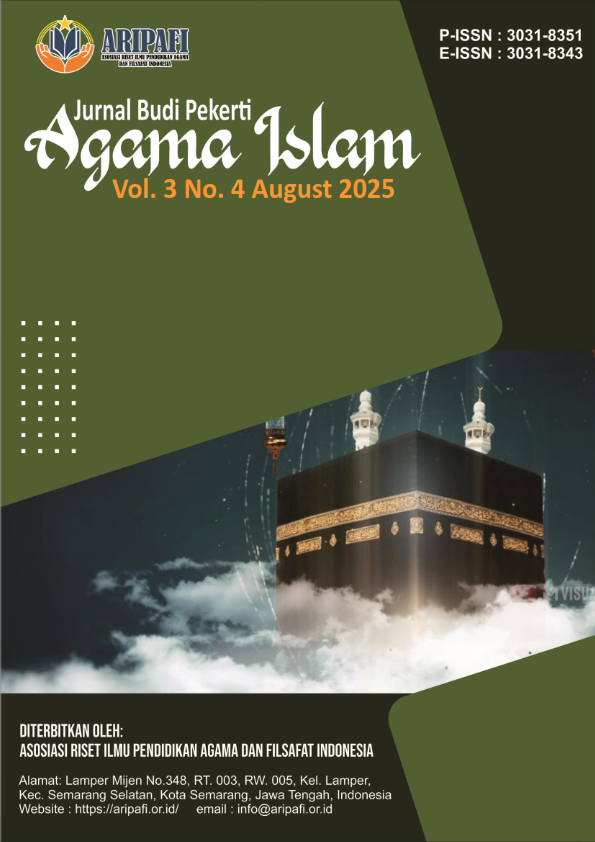
Studi Kritis Bahan Ajar Mata Pelajaran Pendidikan Agama Islam Materi Ibadah Haji dan Kurban Kelas V SDN Bangbayang Cisolok Sukabumi
DOI:
https://doi.org/10.61132/jbpai.v3i4.1392Keywords:
Islamic Religious Education, Hajj and Qurban, Learning Process, Character Building, Curriculum DevelopmentAbstract
The low level of students’ understanding of Islamic practices and values in daily life remains a significant challenge in the teaching of Islamic Religious Education (IRE) at the elementary school level. The teaching of IRE on the topic “Hajj and Qurban” in Grade V at SDN Bangbayang, Cisolok District, plays a strategic role in shaping Islamic character and instilling noble moral values in students. This study aims to critically examine the learning objectives, teaching materials, instructional methods, evaluation system, references, and teaching resources used in the learning process. The research employed a qualitative approach with data collected through classroom observation, interviews with teachers and students, and an analysis of instructional documents. The findings reveal that, in general, the teaching of IRE in Grade V has been implemented in accordance with the objectives and curriculum standards. Teachers have designed teaching modules based on the basic competencies and learning goals outlined in the curriculum. However, several aspects still require further development. Among these are the limited relevance of the learning materials to students’ everyday experiences, the lack of integration of technology-based media, and an evaluation process that places greater emphasis on cognitive aspects while paying less attention to affective and psychomotor domains. This situation indicates that while the learning process is carried out in line with procedural standards, students’ comprehension of Islamic values in practical and contextual terms remains insufficient. Therefore, strengthening the understanding of Islamic teachings in real-life contexts is essential so that students not only acquire theoretical knowledge but are also able to internalize and practice Islamic values in their daily lives. The teaching module currently used is adequate, yet further development is needed to make learning more practical, contextual, and impactful in fostering a strong Islamic character among students.
Downloads
References
Afifah, R., & Mustari, M. (2022). Pengaruh media interaktif terhadap pemahaman manasik haji pada siswa SD. Jurnal Pendidikan Agama Islam Al-Thariqah, 7(1), 55–68. https://doi.org/10.25299/al-thariqah.v7i1.10123
Asrori, M. (2017). Pendidikan Agama Islam dalam pembentukan karakter. Rajawali Pers.
Bloom, B. S. (1984). Taxonomy of educational objectives: The classification of educational goals. Longman.
Creswell, J. W., & Poth, C. N. (2018). Qualitative inquiry and research design: Choosing among five approaches (4th ed.). SAGE Publications.
Hamalik, O. (2011). Proses belajar mengajar. Bumi Aksara.
Kemendikbudristek. (2022). Profil Pelajar Pancasila dalam Kurikulum Merdeka. Kemendikbudristek.
Kementerian Pendidikan dan Kebudayaan. (2021). Buku guru Pendidikan Agama Islam dan Budi Pekerti kelas V. Kemdikbud.
Lincoln, Y. S., & Guba, E. G. (1985). Naturalistic inquiry. SAGE Publications.
Mardapi, D. (2012). Pengukuran, penilaian dan evaluasi pendidikan. Nuha Medika.
Miles, M. B., Huberman, A. M., & Saldaña, J. (2014). Qualitative data analysis: A methods sourcebook (3rd ed.). SAGE Publications.
Moleong, L. J. (2017). Metodologi penelitian kualitatif (Edisi revisi). Remaja Rosdakarya.
Mulyasa, E. (2013). Pengembangan dan implementasi kurikulum 2013. Remaja Rosdakarya.
Munir, M. (2017). Evaluasi pembelajaran Pendidikan Agama Islam dalam ranah afektif. Jurnal Ilmiah Islam Futura, 17(2), 189–205. https://doi.org/10.22373/jiif.v17i2.1325
Nata, A. (2015). Pendidikan Islam di sekolah: Teori dan praktik. Kencana.
Nurhayati, I. (2019). Strategi guru dalam mengatasi kesulitan siswa memahami materi ibadah. Jurnal Edukasi Islami, 8(1), 33–45.
Prastowo, A. (2012). Panduan kreatif membuat bahan ajar inovatif. Diva Press.
Qomariyah, S. (2023). Kompetensi kepribadian guru Pendidikan Agama Islam dalam pembentukan syakhsiyah Islamiyah siswa. Jurnal Pendidikan Agama Islam, 9(2), 145–157.
Rahman, M. (2021). Pengembangan bahan ajar PAI berbasis multimedia interaktif untuk meningkatkan pemahaman ibadah haji. Jurnal Edukasi Islam, 7(2), 122–134.
Sari, N. L., & Hidayat, D. (2020). Pembelajaran kontekstual untuk meningkatkan pemahaman keagamaan siswa SD. Jurnal Pendidikan Dasar Nusantara, 5(2), 77–89.
Yusuf, M. (2021). Peran Pendidikan Agama Islam dalam membentuk karakter siswa di sekolah dasar. Jurnal Tarbiyatuna, 12(1), 23–35.
Zaini, H. (2015). Kontekstualisasi Pendidikan Agama Islam di sekolah dasar. Jurnal Pendidikan Islam, 4(1), 45–59.
Zuhairini, Z. (2017). Pendidikan Agama Islam. Bumi Aksara.
Downloads
Published
How to Cite
Issue
Section
License
Copyright (c) 2025 Jurnal Budi Pekerti Agama Islam

This work is licensed under a Creative Commons Attribution-ShareAlike 4.0 International License.